 In this area
The Beijing issue
Chaoyang CBD, Beijing: glass towers, sky bars and the city’s sharpest modern address
Beijing’s most corporate district is also its most vertical: come for the skyline, the subway hub and the serious dining, stay for the view from above.
By Zhao MeilinReading Beijing's living history
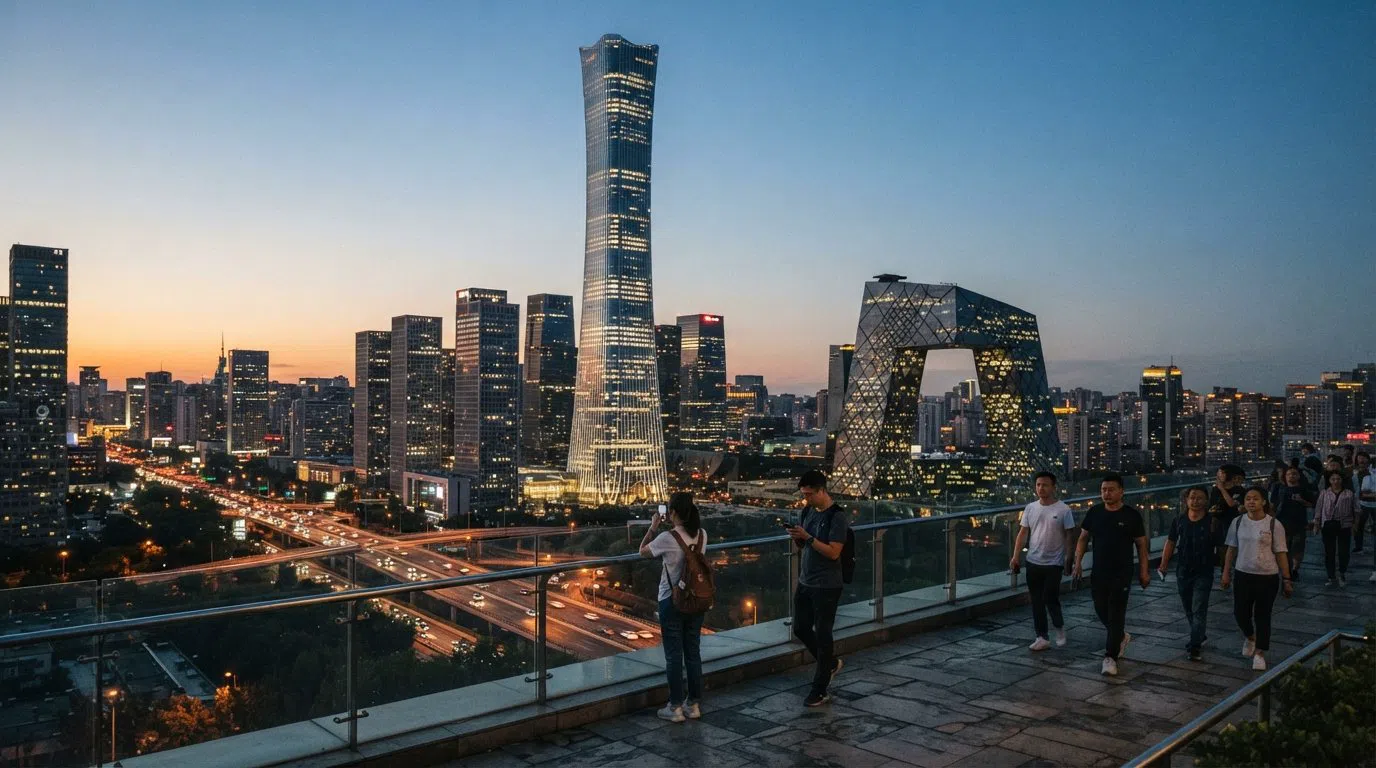
Beijing has 3,000 years of imperial history, and none of it is here. On the east side of the Third Ring Road, around Guomao, the city shows a different face: the 528-metre China Zun rising like a polished bronze vessel, the CCTV Headquarters looping over the avenue like a pair of trousers somebody hung in the wrong place and never took down, and the long, glassy run of the China World complex anchoring the district at street level. It is corporate Beijing, yes, but with better lighting than that sounds. You come here for the lift ride, the clean subway line, the terrace dinner and the skyline that keeps performing after dark.
What the Chaoyang CBD is known for
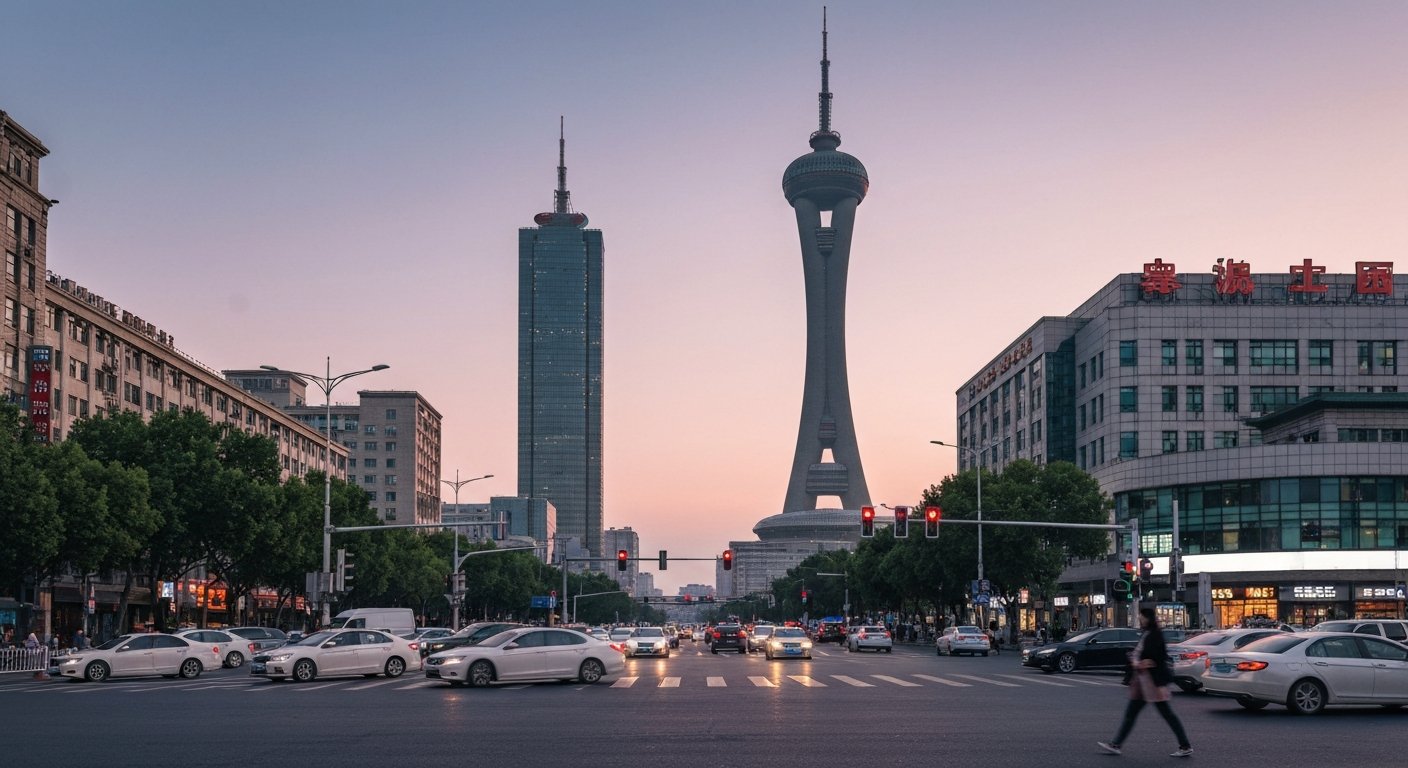
The Chaoyang CBD is Beijing built from scratch, and it does not pretend otherwise. This is not a district of hutong corners, temple bells or old courtyards fading into the afternoon. It is a dense grid of office towers, luxury malls and international hotels bounded roughly by the East Second and Third Ring Roads, running from Chaoyangmen down to Guomao. By day, it moves to the rhythm of meetings and flat whites. The Guomao interchange swallows a third of a million people a day. Sky bridges carry office workers between towers with the brisk efficiency of people who have somewhere to be and no patience for detours.
The skyline is the district’s whole argument. The China Zun, officially CITIC Tower, is the tallest building in Beijing at 528 metres and 109 floors, its curving form modelled on the ancient zun ceremonial wine vessel. It is a working tower rather than a tourist attraction, which is the first useful thing to know about it. The observation deck has never opened to the public, so the correct response is not to queue but to look up from the street, or better, from a rival rooftop where the whole silhouette can be read in one glance.
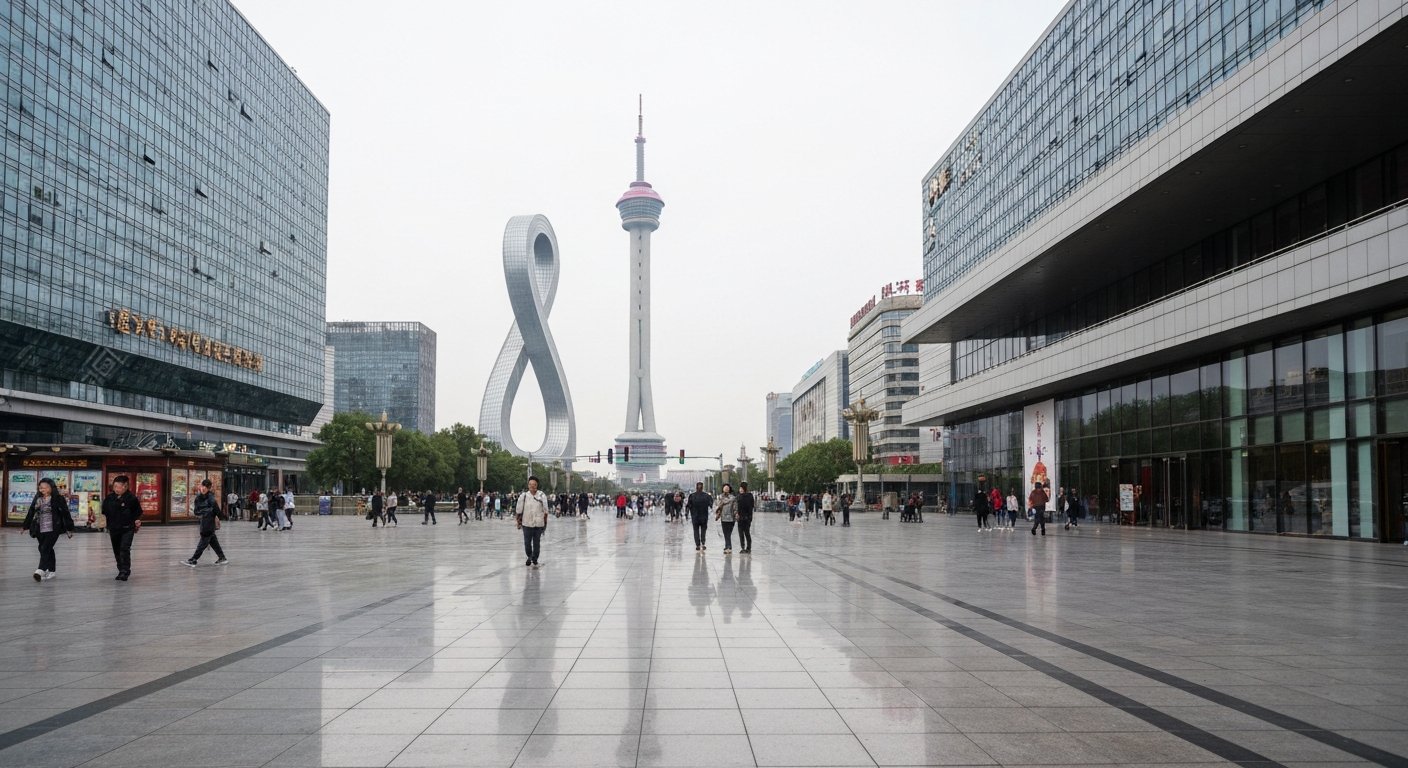
The CCTV Headquarters is the other landmark that everyone photographs and almost nobody enters. Designed by Rem Koolhaas and Ole Scheeren and completed in 2012, it is not really a tower at all but a continuous loop: two leaning structures joined at top and bottom. Beijing taxi drivers long ago gave it the nickname dà kùchǎ, “the big pants,” and the name has stuck because it is blunt, funny and accurate in the way local nicknames often are. The building is closed to tours, but its profile is the city’s most recognisable modern outline.
At ground level, the older China World Trade Center complex gives the district its Chinese name, Guomao, and its practical spine. The towers, malls, offices and hotels here are less theatrical than the newer icons, but they are what make the neighbourhood work. This is the CBD’s real trick: the architecture does the talking, but the subway, the malls and the hotels do the living.
Plan your Beijing trip
Live prices from our booking partners.
Guests & rooms
Free cancellation on many rooms. We may earn a commission when you book.
Where to eat & drink
The CBD punches hardest at the top end, which is exactly where it should, given the way the district is built. Beijing’s first three-Michelin-star Chinese restaurant is here: Xin Rong Ji, on Xinyuan South Road in the ground floor of the Genesis Beijing tower. It serves refined Taizhou cuisine and East China Sea fish, and its signature is a 28-day-old baby Peking duck that must be pre-ordered. That detail matters. In a city that can sometimes confuse prestige with noise, Xin Rong Ji understands ceremony without fuss. It is serious dining, booked weeks ahead, and the room has the calm confidence of a place that knows people came for the cooking, not the theatre.
Chao Shang Chao (Chaoyang), at the CP Center on Jinhe East Road, is the other three-star room worth making a plan for. Under chef Yat Fung Cheung, who took the inaugural Beijing Michelin Mentor Chef Award in 2026, it serves elegant Chaozhou cooking with a particular eye for dried fish maw and tasting menus that do not come cheap. The food is refined, the bookings are managed in-house, and the room fills fast. If Xin Rong Ji feels like a masterclass in restraint, Chao Shang Chao is its more ornate cousin.
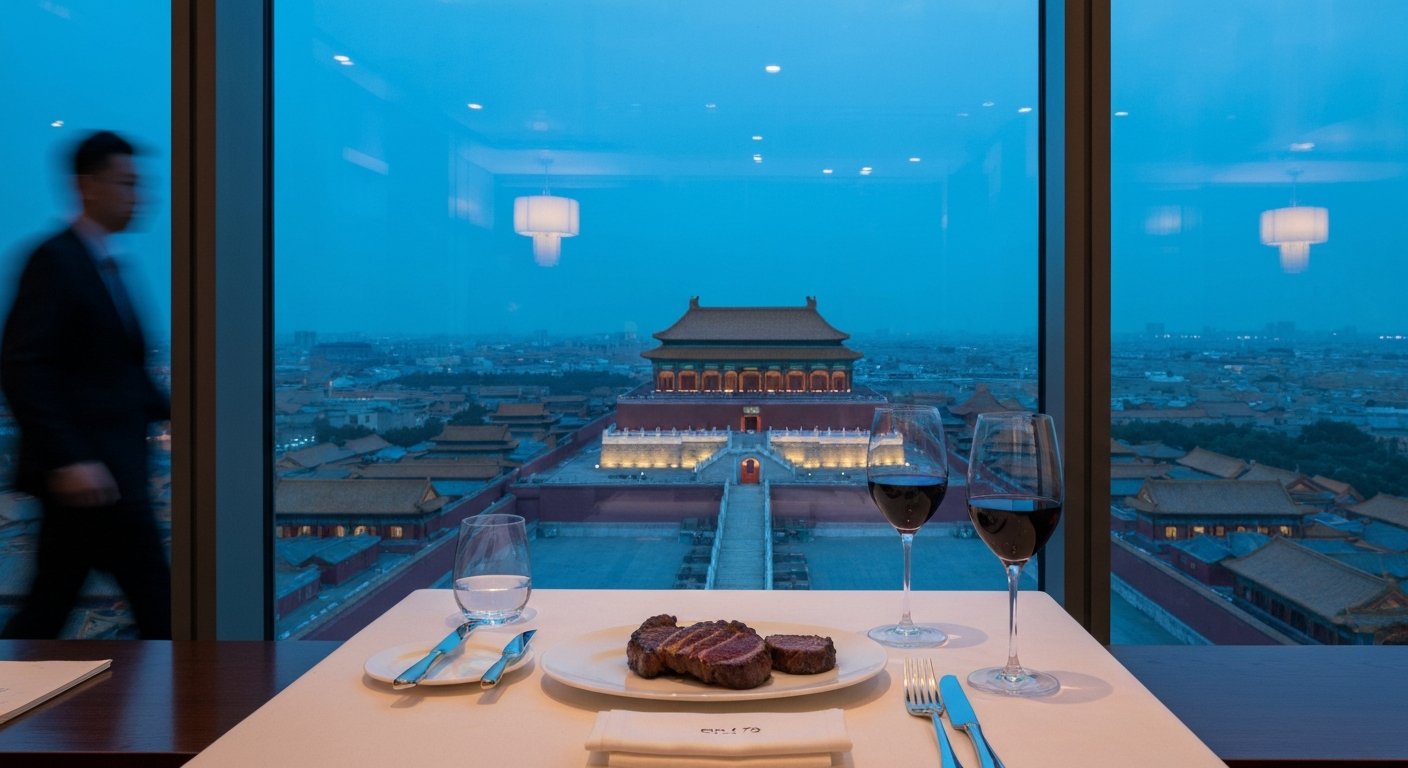
For the view with your dinner, the China World Summit Wing is the district’s great stage set. Grill 79, on the 79th floor, is a modern-European grill and steakhouse with Boston lobster, premium beef cuts and a 600-label wine list, and the windows reach toward the Forbidden City. It is expensive, of course, but the setting earns its keep. Here, the city is not abstract; it is laid out below you in layers of glass, road and distant roofline.
Down in the China World Mall, the seventh-floor terrace keeps the district’s best casual skyline lunch within reach. Migas Mercado does Spanish tapas, paella and Iberian ham, and on weekend nights it turns into a proper bar with DJ sets. The terrace looks straight at the CCTV Tower and China Zun, which is the sort of view that makes even a plate of ham feel architectural. Blue Frog, on the sixth floor, is the easy-going counterpart: burgers, happy-hour cocktails and the same skyline from a slightly lower angle. On the fifth floor, Din Tai Fung in Guomao is the reliable answer when you want xiaolongbao and dumplings without making a production of it.
If you want the towers and a drink without the full hotel-bar bill, Xun Terrace on the 25th floor of Digital Plaza on Guanghua Lu pours cocktails and Western mains from 4pm. It is a useful place to remember, the sort of terrace that does not shout about itself but quietly gives you the city back at a manageable price point. And if you are here for the view and not the cuisine, that is often enough.
Going out
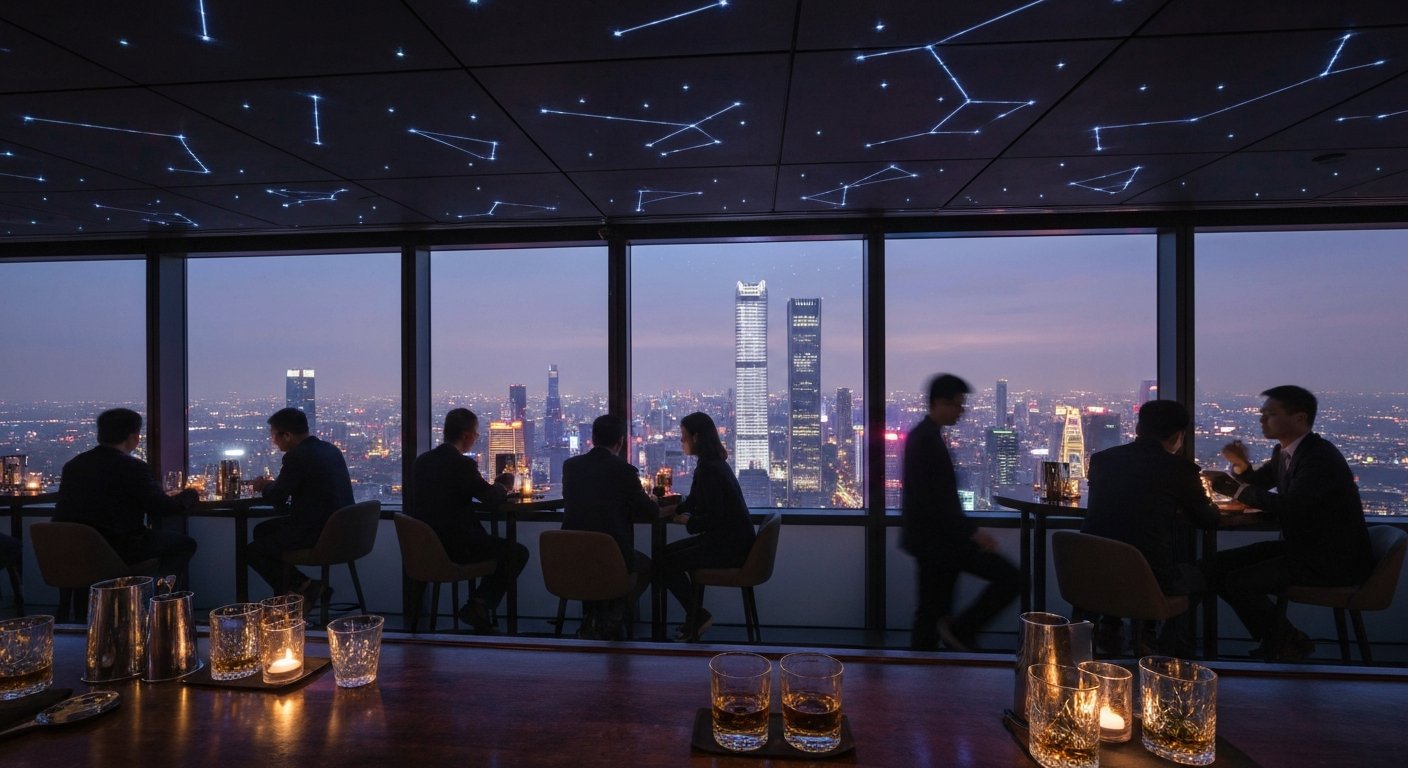
The CBD does not do raucous street-level nightlife. For that, you cross town to Sanlitun or into the Gulou hutongs, where the pavements stay lively long after office hours. Here, the drinking is polished, vertical and mostly attached to hotels. The headline is Atmosphere, on the 80th floor of the China World Summit Wing, which bills itself as Beijing’s highest cocktail bar. That claim is not the point by itself. Plenty of places can say they are high. Atmosphere earns the title with the room itself: monochrome grey and black, a ceiling lit like a constellation, a deep single-malt list and live music most nights. The wraparound skyline is the real performance, with the CCTV loop, the Zun and, on a clear evening, the Forbidden City’s rooftops far below.
It runs roughly from 2pm to 2am on weekdays and opens earlier at weekends, which makes it one of the few places in Beijing where you can watch the city change posture from afternoon glass to night reflection without moving your seat. Come before sunset for the light, and dress smart. This is not the kind of room that rewards carelessness.
The after-work crowd also spills onto the mall terraces. Migas Mercado becomes more bar than restaurant on weekend nights, with its DJ programme doing the work that a street scene might do elsewhere. Blue Frog’s happy hour pulls in office workers who are not yet ready to go home. Beersmith, on the ground floor of the JEN Beijing hotel, adds a more relaxed note with fresh brewery beer in a greenery-filled room that stays open late. In warmer months, CLUB ME on the sixth floor of the Yintai Center throws poolside parties in a pool-and-beach-themed setting that feels almost mischievous for Beijing. Almost, but not quite. This is still a grown-up district, and it knows it.
Things to do
The honest truth about the CBD’s headline sights is that you look at them rather than go inside. The China Zun and the CCTV Headquarters are both closed to public tours, which is mildly disappointing only if you expected otherwise. The better move is to photograph the CCTV loop from ground level, where the plaza around China World Mall gives a clean line on the building, and then buy the view rather than the ticket. The district’s pleasure is not in monument-chasing but in finding the right height from which to read the skyline.
Since the China Zun’s own observation deck has never opened, the best skyline vantage remains a drink at Atmosphere or a table at Grill 79, both of which reach across the CBD to the Forbidden City on a clear day. That is the neat trick of the neighbourhood: the most impressive vistas are not hidden in a special attraction but tucked into the ordinary business of eating and drinking well.
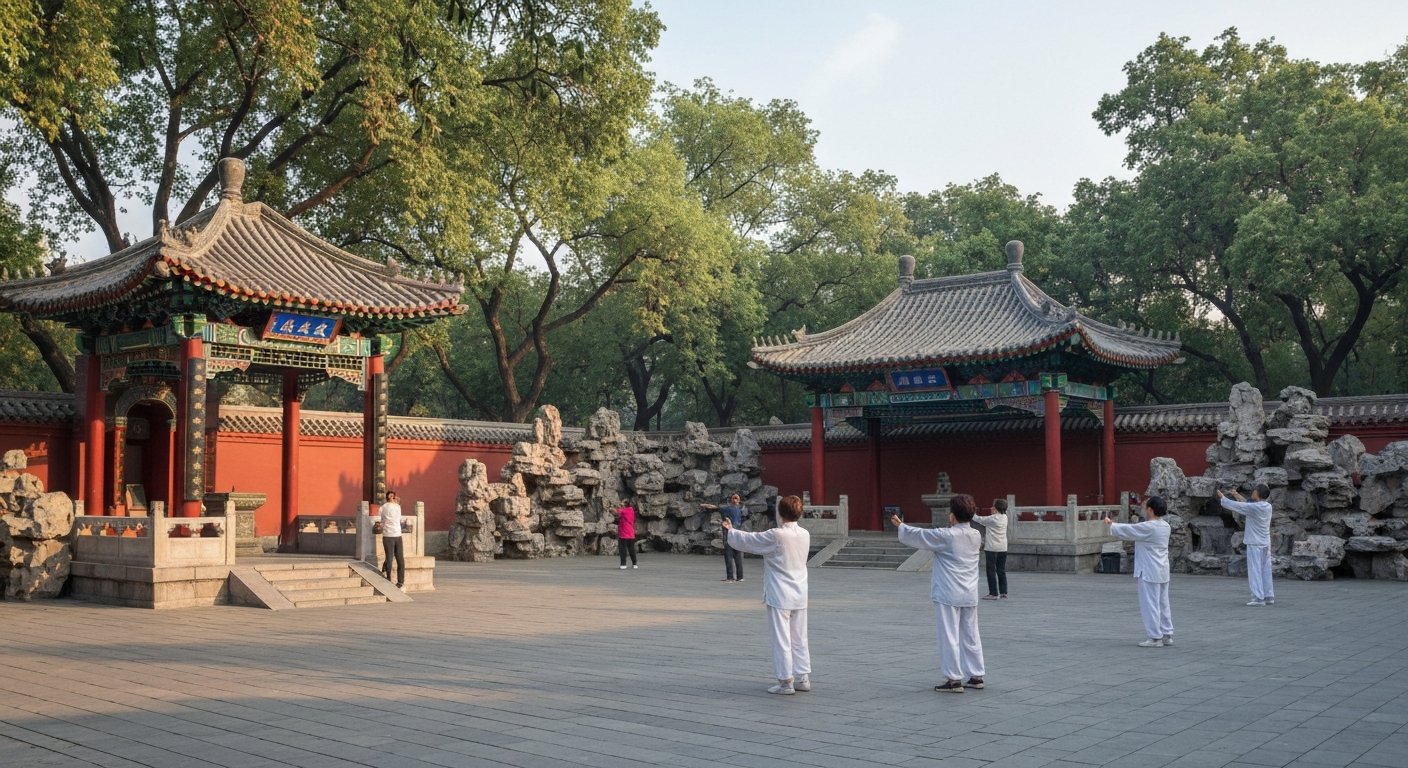
For a change of pace, head a few minutes west to Ritan Park. It is a leafy pocket built around a 16th-century Ming altar where emperors once made sacrifices to the sun, and it feels like the district exhaling. There are pavilions, rock gardens and locals doing tai chi, all of it a calm counterpoint to the glass towers and ring roads. The park does not try to compete with the CBD’s scale; it simply reminds you that Beijing can still make room for a little quiet.
If you need more art and culture, the 798 Art District and the temple-and-hutong sights around Yonghegong are a short subway ride north, and Sanlitun’s bars and shopping are roughly 15 minutes by taxi. But the CBD itself works best as a base rather than a checklist. It is a place to sleep, to meet, to look out from, and then to leave again on the subway.
Don’t miss in Chaoyang CBD
The striking, angular architecture of the CCTV Headquarters.
The high-end galleries and dining options inside the Parkview Green shopping complex.
Shopping
This is where Beijing does luxury properly. Beijing SKP on Jianguo Road is the flagship, a department store so productive it regularly tops global rankings for single-store sales. The scale is serious: roughly 180,000 square metres, open from 10am to 10pm, with the full designer roster spread across its floors — Hermès, Chanel, Louis Vuitton, Dior, Gucci, Prada. It is the sort of place where the air feels expensive before you have bought anything. That said, it is also practical, and in this district practicality and prestige often arrive in the same lift.
Across the road, SKP-S, created with Korean eyewear label Gentle Monster, turns shopping into a surreal art-and-technology installation over four floors. Even if you are only browsing, it is worth a wander. The point is not merely the merchandise but the staging, and Beijing does not often indulge in this kind of theatrical retail without a reason.
The other major address is the China World Mall at Guomao, a 230,000-square-metre high-end centre threaded directly into the China World Trade Center and the subway. It carries the international luxury names, a strong food line-up and, in the basement, a full-size ice-skating rink. That rink is a useful reminder that the CBD is not only for expense accounts and terrace dinners. It is a working urban machine, and it has room for children, commuters and people trying to kill time before dinner upstairs.
There are no street markets or souks here, no haggling under awnings. The CBD is built for climate-controlled, top-tier retail. If you want the Silk Street market at Yong’anli or the antique stalls of Panjiayuan, you go elsewhere. Here, you shop under glass.
Where to stay in the Chaoyang CBD
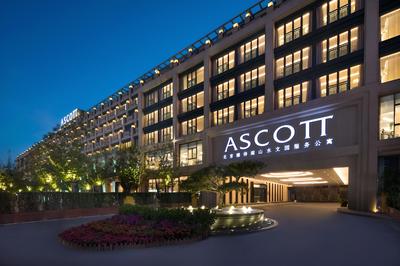
The CBD is Beijing’s densest cluster of international five-stars, and the logic of staying here is simple: you trade old-character charm for height, convenience and a view. The showpiece is the China World Summit Wing, Beijing, which occupies the upper floors of a 330-metre tower and holds Grill 79 and Atmosphere above the city. If the point of the trip is to wake up in the skyline, this is the one to choose.
The China World Hotel, also Shangri-La, sits in the same Guomao complex three minutes from the subway, with an indoor pool and direct mall access. It is the more grounded sibling, less showy but excellent at what it does. Kerry Hotel Beijing is the playful family-friendly option, with a large sports centre, a children’s adventure park and a brewpub. The St. Regis Beijing, north near Jianguomen, brings classic butler-service luxury closer to Ritan Park and the embassy quarter. JEN Beijing by Shangri-La is the relative value pick, plugged straight into the China World complex’s malls, offices and subway.
Staying at Guomao puts you on top of the subway, the malls and the best skyline dining. A base a little north around Jianguomen edges you toward Ritan Park and quieter, greener streets. Prices are firmly at the upper end, but the trade-off is a spotless, ultra-connected district with meetings, shopping and transit at your feet. If you want hutong character or a walk to the Forbidden City, base further west. If you want a modern, business-luxury Beijing with the towers outside your window, this is the sharpest call.
Hotels in Chaoyang CBD
Our best-rated stays in this neighbourhood. Prices are approximate “from” rates — confirmed at the provider when you continue. We may earn a commission if you book through our partners — at no extra cost to you.
In this area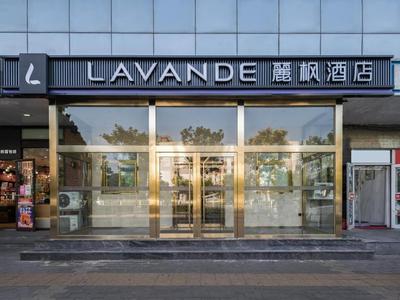 In this area
Chaoyang CBD
Lavande Hotel Beijing Industry University Metro Station
0.0· 0 reviews
approx. from£48 / nightSee prices
Getting around
The CBD is one of the best-connected corners of Beijing, and Guomao station is the hub. It is an interchange between Line 1 and Line 10, wired directly underground into the China World Trade Center complex, and it handles around 140,000 transfers on a typical weekday. That sounds like a statistic until you stand there and feel it: the steady current of people moving through the concourse, the escalators never quite empty, the sense that the whole district is plugged into the city’s circulation.
From Guomao, Line 1 runs due west along the imperial axis to Wangfujing, Tiananmen and the Forbidden City in about 15 to 20 minutes. Line 10 loops the city and links to Sanlitun at Tuanjiehu and the north. Dawanglu on Line 1 and Jintaixizhao on Line 10 sit at the district’s edges, so almost nowhere in the CBD is far from a station. Above ground, the district is flat and walkable, with malls, hotels and towers linked by plazas and sky bridges, but the wide ring roads and rush-hour traffic make the subway the sensible choice at peak times.
For taxis, use Didi rather than hailing on the street, especially late. Getting to the airports is straightforward: for Beijing Capital, take Line 1 or 10 to the Airport Express interchange at Dongzhimen, about 45 minutes to an hour door to door. Beijing Daxing is further out and best reached by the Daxing Airport Express or a Didi, around an hour. For a short stay, the subway plus the occasional Didi covers almost everything.
The CBD is extremely safe day and night, clean, and businesslike to the bone. It empties out on weekends, which some travellers will find a relief and others a little cold. That is the bargain here. You are not coming for a neighbourhood scene. You are coming for a tower, a table, a train line and the city spread out below you.
Gallery
Chaoyang CBD in pictures
Chaoyang CBD — your questions
Is Chaoyang CBD a good area to stay in Beijing?
Yes — if you want a modern, business-luxury base with Beijing’s best skyline dining and an unbeatable subway hub at Guomao. It suits business travellers, food-focused trips and anyone who wants a five-star tower with a view. It is less good if you came for old-Beijing character or want to walk to the Forbidden City, though the imperial sights are only about 15 to 20 minutes away by subway.
Can you go up the China Zun or the CCTV Headquarters?
No. The China Zun (CITIC Tower), at 528 metres the tallest building in Beijing, has viewing floors near the top, but its observation deck has never opened to visitors. The CCTV Headquarters is not open for tours either. To see the CBD from above, book Grill 79 or Atmosphere in the China World Summit Wing.
Where is the best skyline view in Chaoyang CBD?
Atmosphere on the 80th floor of the China World Summit Wing is the highest cocktail bar in Beijing, with a wraparound skyline view. Grill 79 just below it is another strong perch. For a more relaxed option, try Migas Mercado, Blue Frog or Xun Terrace for views of the CCTV Tower and China Zun.
What is the best way to get around the CBD?
Use the subway. Guomao is the key interchange, linking Line 1 and Line 10 directly into the China World complex, and most of the district sits close to a station. Taxis are easiest via Didi, especially late or in rush hour.